
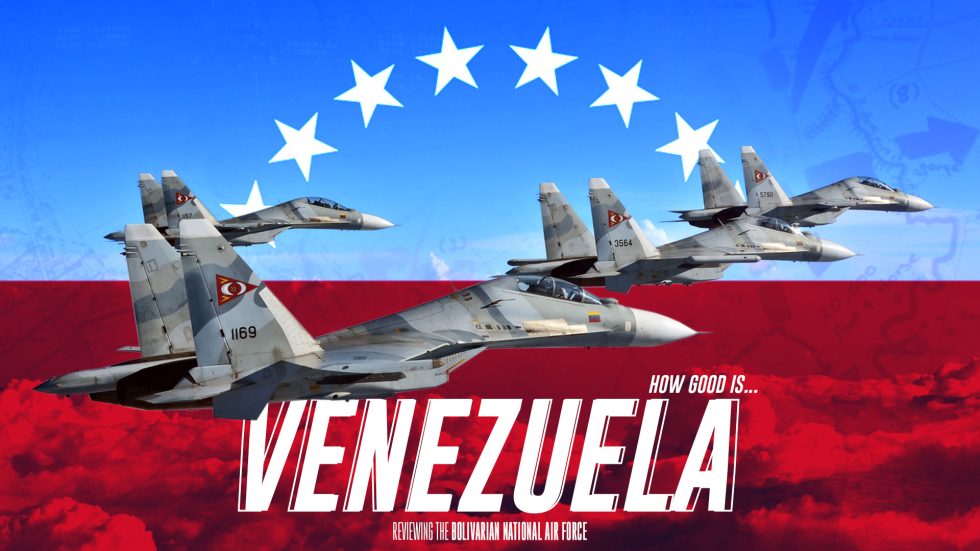
How good is Venezuela’s air force? Amid sanctions and economic woes, it fields 21 operational Su-30MK2 fighters for air superiority and strikes with R-77 missiles, plus 3-5 F-16s, but older Mirages are grounded. Bolstered by S-300 SAMs, SA-17s, and MANPADS for layered defense, readiness remains limited, posing challenges in regional conflicts like potential U.S. interventions.
Venezuela’s security environment has grown more complex because of U.S. counter-narcotics operations in the Caribbean and visible aerial patrols with platforms like the B-52 Stratofortress. In response, Venezuelan officials have accused the United States of using anti-drug missions as a pretext for destabilization and regime change, citing a history of geopolitical tension and economic sanctions.
In this context, any potential military confrontation would involve the Bolivarian National Armed Forces, especially the Venezuelan Air Force (Aviación Militar Bolivariana). While the United States would likely maintain air superiority in a conventional conflict, the Venezuelan Air Force’s Su-30MK2 multirole fighters and mobile surface-to-air missileSurface-to-Air Missile: A ground-based or ship-launched guided missile system designed to detect, track, and destroy enemy aircraft, helicopters, crui... More systems could complicate U.S. operations, particularly in contested coastal areas.
Today we look at the composition, history, and operational viability of Venezuela’s air force—its strengths, limitations, and how much credible resistance it could present in a modern air campaign.
HISTORY
The Bolivarian National Air Force expanded in the late 1950s, driven by government programs that modernized its fleet. These acquisitions reflected regional air power trends and paralleled platforms used by countries like Australia. Early jet fighters and tactical bombers marked Venezuela’s shift from piston to jet aviation.
A variety of iconic Commonwealth aircraft made up much of the air force; strike aircraft would include the de Havillandde Havilland Aircraft Company: A seminal British aerospace manufacturer founded in 1920 by Sir Geoffrey de Havilland, recognized for its radical innov... More Vampire FB 52, the DH112 Venom FB-54, and 34 Canberra bombers – including the B-82 Mark I, B 88 Mark I, T 84, and PR 83.
This was complemented by two types of fighters: 32 F-86F Sabres and 79 F-86K Sabre Dogs purchased from a Fiat plant in West Germany.
In other words, during these formative years, the air force was quite substantial.
This fleet underwent modernization similar to the Royal Australian Air Force (RAAF). By the 1970s, boosted by a surge in oil revenues from global price shocks caused by conflicts in the Middle East, Venezuela invested heavily in expanding and upgrading its air capabilities. This period marked a strategic shift, with acquisitions focusing on advanced trainers, strike aircraft, and multirole platforms, signaling the country’s ambition to maintain a credible and regionally competitive air force. For forward observation, training, and close air support, a fleet of T-27 Tucanos was purchased, along with the OV-10 Bronco.
For advanced training, the Air Force acquired an initial batch of 12 T-2 Buckeyes, a US Navy intermediate jet trainer from the late 50s.
Then came the strike and fighter aircraft. Between 1972 and 1974, Canada sold off 20 CF-5A and D aircraft to Venezuela. These were license-built derivatives of the F-5A Freedom Fighter, thus being capable of both air superiority and strike missions.
The main fighting force would consist of Mirages; seven Mirage IIIs would be purchased in the 70s, all of which were custom-built III-EVs, a derivative of the E, thus being single seaters with more modern equipment such as TACAN integration.
These would be followed by six Mirage 5Vs, again a custom single seater built specifically for Venezuelan export. The 5V would be adapted for ground attack.
Next came the Mirage 50EV, a Mirage 5 modified for a fighter-bomber role. The 50EV featured forward canards, a refueling probe, new INSINS (Inertial Navigation System): A self-contained navigation system used in military aircraft that calculates position, velocity, and orientation wit... More, radar, RWR, and countermeasures systems. It was also equipped with a digital heads-up display.
Crucially, it would be capable of using the French-built Exocet ASM, which gave the Venezuelans more effective precision standoff capability against incoming vessels.
13 of the 50EVs would enter service; six actual custom-built models, and seven conversions; two Mirage IIIEVs, two Mirage 5Vs, and three Mirage 5Ms purchased from Zaire.
AIRCRAFT IN SERVICE
Today, the air force has upgraded again, though not to its previous extent.
As one of the first export customers of the F-16, Venezuela received the F-16 Block 15 in 1983. In total, 18 single-seat A models and 6 twin-seat B models were purchased. Since 1992, however, sanctions have prohibited the sale of weapons parts for the Viper, cutting off the lifeline needed to keep them running. Reportedly, only 3 to 5 F-16As and one B remain operational, with the rest grounded.
At one point, the air force also had access to one or possibly two BoeingThe Boeing Company: A global aerospace leader and one of the world’s largest defense contractors, specializing in the design and manufacture of milita... More 707s modified for refueling. This is similar to what other air forces have done, including Iran in the 70s and 80s with ‘KC-707s’, and Israel today, which appears to unofficially operate similar modified 707s as a budget alternative to the KC-135. Whether Venezuela still has access to such an aircraft remains uncertain, with conflicting reports about its fate.
However, the primary modernization effort to bypass sanctions was the acquisition of the SukhoiSukhoi – A prominent Russian aerospace and defense corporation specializing in the design and manufacture of military aircraft, particularly fighter a... More Su-30. In 2006, Venezuela agreed to acquire 24 Su-30MK2s. According to various sources, 3 are unaccounted for, with 21 known to be in service. These aircraft would replace the Mirage, operating in a multirole capacity. Crucially, it would be purchased alongside the Russian-built Kh-31, coming in two variants: an anti-radiation missile and an anti-ship missile.
The Su-30 in question is the MK2 AMV, a derivative of the Chinese export MKK and part of the Flanker G family built by Irkutsk. Unlike the name suggests, the MK2 AMV differs from both the initial MK2 and the Vietnamese MK2V. The AMV was uniquely built in its initial batch using early Su-35 airframes as a base, modified to a twin-seat standard, and outfitted with the relevant suites for the platform.
Further purchases are rumored as Venezuela seeks to bolster its defenses. Reports suggest another 12 Su-30s may be on order, along with a possible revival of a failed deal to secure a similar number of new air superiority fighters, specifically the Su-35SE, a derivative built by the Komsomolsk-on-Amur Aircraft Plant (KnAAPOKnAAPO (Komsomolsk-on-Amur Aviation Production Association) – A major Russian aircraft manufacturing plant located in Komsomolsk-on-Amur in the Russia... More) for the Iranian Air Force. Whether this is true remains to be seen.
OTHER TECH
Beyond its main force, Venezuela operates a small number of utility and attack helicopters, including Mi-17s for transport, AS332 Pumas, and at one point Hinds for attack, though the status of these remains unknown.
Fixed-wing utility aircraft include the C-130 and Shaanxi Y-8, along with various smaller civilian-grade fixed-wing and rotary aircraft that can fill a range of transport and logistics roles.
In 2007, Venezuela signed a $28 million agreement with Iran to acquire and locally assemble Mohajer-2 tactical UAVs, rebranded as ANSU-100 ‘Arpía’ drones. These were assembled at the Cavim military complex using Iranian knock-down kits, with at least 12 built by 2012. Though some reports mentioned higher intended numbers, only a dozen are confirmed operational. These UAVs are primarily used for reconnaissance and surveillance and mark Venezuela’s most significant tactical drone acquisition to date.
Finally, the situation with defensive equipment remains unclear. Venezuela reportedly operates an unconfirmed number of S-300 gladiators, mobile SAMSurface-to-Air Missile: A ground-based or ship-launched guided missile system designed to detect, track, and destroy enemy aircraft, helicopters, crui... More sites that can also serve as anti-ballistic missile systems. Alongside these are smaller, more mobile SA-17s, the successor to the SA-6, which are radar-guided and offer medium-range coverage. For point defense, the military fields a modernized S-125 system, the Pechora 2M, built in 2000, with around 24 to 44 such systems in use.
These major systems are supplemented by ZU-style AA guns and Man-Portable Air Defense Systems (MANPADS), including the Swedish-built RBS 70 and Russian IGLA-S, the latter with a greater effective range than the Stinger.
OVERALL CAPABILITIES
The Venezuelan Air Force is much smaller than it was at its peak in the late 20th century, both in fleet size and operational scope. Years of economic hardship, international sanctions, and logistical constraints have hurt its maintenance capacity and readiness, leaving much of its older equipment grounded or in limited use. As a result, its true combat effectiveness is difficult to assess with confidence.
Theoretically, these F-16s were restricted to AIM-9Ls, but photos confirm that the Israeli military has since assisted in upgrading them. According to images, they now field both the Python-4 infrared missile and the LITENING targeting podLITENING Targeting Pod: An advanced multi-sensor targeting pod manufactured by Northrop Grumman that provides military aircraft with precision targeti... More. It has also been reported that Venezuela may have received precision air-to-ground munitions from Israel, which are compatible with the F-16A.
The air defenses are also serious, even against modern aircraft. The S-300 remains formidable, with wide coverage when positioned correctly. The most immediate threat may come from the 12 SA-17s, or Buk M2, in Venezuelan service, which have an 80,000-foot intercept ceiling and strong overall performance.
It should be noted that in the Russo-Ukrainian war, this system was noted by Ukrainian Fulcrum pilots as being their biggest concern when on mission.
All known Venezuelan air defense systems are mobile, from vehicle systems to shoulder-mounted weapons and towed AA guns. This mobility makes mission planning, Suppression of Enemy Air Defense (SEADSEAD (Suppression of Enemy Air Defenses): A military operation designed to neutralize, destroy, or temporarily degrade enemy air defense systems to al... More) missions, and regular operations riskier for US pilots because of the rapid deployment and escape these systems allow.
In practice, these systems cannot be underestimated, even against modern fighters. This threat was shown in March, when officials claimed an F-35 was forced into evasive maneuvers by Houthi air defenses over Yemen, and seven MQ-9 drones were reportedly downed by similar systems. The Houthis claim they have used systems like Venezuela’s to down or damage various Saudi jets, including F-16s, F-15s, drones, and Tornados.
In terms of air power, the Flanker serves as the main defense, equipped with the R-77 missile and anti-ship munitions, making it a threat to Navy craft. While these aircraft lack stealth, they can rival the Super Hornet in a multirole capacity, offering strong BVRBVR (Beyond Visual Range): In aerial warfare, engagements or combat operations that occur at distances where opposing aircraft cannot visually identif... More capabilities and limited electronic warfare and jamming. The US would likely try to destroy these aircraft on the ground, but if airborne, they could pose a serious threat.
Thus, in the final analysis, while the Venezuelan Air Force would be unable to withstand or repel a sustained air offensive by the U.S. Navy and Marine Corps, its combination of advanced Su-30MK2 “Flanker” fighters and a layered network of mobile, radar-guided air defense systems—including long-range SAMs and MANPADS—would significantly complicate any aerial incursion. This mix of capabilities could increase the operational risks for attacking forces, particularly in the early phases of a conflict or during missions conducted near Venezuelan airspace.
If open hostility occurred, the US would likely use ground assets such as CIA field teams or special forces to geolocate air defenses. Due to the risk of shootdowns, drones would likely play a crucial role in the initial acquisition, targeting, and possibly destruction of ground threats, whether air defenses or aircraft. This would help avoid CSAR operations over defended territory, so stealth drones like the Sentinel might be used for this purpose.
In terms of manned airpower, increased pressure from air defenses and Flanker aircraft would push planners to rely more on stealth assets like the B-2 bomber, F-35s, and F-22s. Aircraft would aim to neutralize threats on the ground, as seen in modern first strikes, but if that is not possible, US air assets would have to face the SU-30, which may be Venezuela’s greatest direct threat to incoming aircraft.
While small, Venezuela’s air force isn’t toothless—and in the right conditions, it could still bite. With modern fighters, layered defenses, and a volatile geopolitical climate, it remains a force worth watching closely.


