
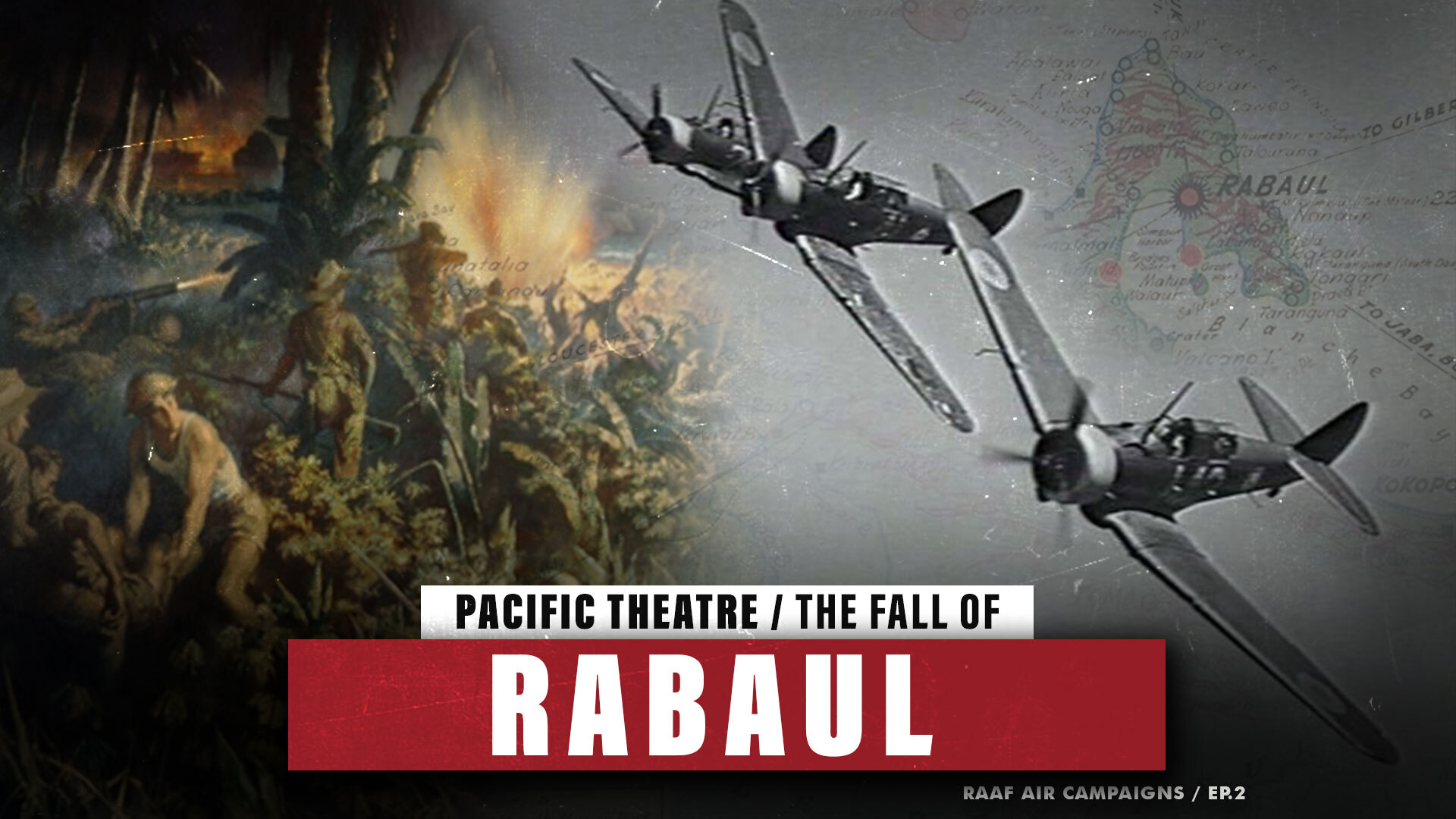
In January 1942, the Australian outpost at Rabaul stood directly in the path of Japan’s advance across the Pacific. Poorly defended, under-equipped, and relying on outdated aircraft, the men of the RAAF and Lark Force faced overwhelming odds as Japanese air raids intensified and invasion loomed.
The Fall of Rabaul
After the attack on Pearl Harbor on December 7, 1941, Australia’s War Cabinet asked the Chiefs of Staff to assess Japan’s plans. They considered that Japan might attack Australia directly from aircraft carriers, or gradually conquer Singapore and the Netherlands East Indies before invading. Japan could also target strategic bases such as Rabaul, Port Moresby, and Noumea, or seize Darwin. These possibilities raised serious concerns, given Australia’s limited resources.
This is the story of the fall of Rabaul, the important yet poorly defended base in New Britain.
In December, the Australian War Cabinet decided to pause the Empire Air Training Scheme’s overseas deployment, which had been 620 per month. Australia urgently needed aircrew for local roles, and with the Japanese Navy posing a threat, sending personnel abroad had become too risky. As a result, Australian aircraft, particularly Hudsons at Rabaul and Catalinas at Port Moresby, prioritised locating Japanese vessels. In December 1941, the Catalinas from 11 and 20 Squadrons carried out over 100 reconnaissance and search missions, covering regions such as New Caledonia, the New Hebrides, the Solomons, and New Ireland.
Situated on Simpson Harbour in northeastern New Britain, Rabaul is surrounded on three sides by volcanic craters. Although there were good local roads, none connected Rabaul to the rest of the mountainous, jungle-covered island and were unsuitable for motor traffic. The main basic airstrip, Vunakanau, was about 16 kilometres south of Rabaul and had a single runway cut through the kunai grass.
In early December, No. 24 Squadron’s limited number of Hudsons and Wirraways were deployed to the outpost.

Peter White, 23 Squadron Pilot
24 Squadron was based at Garbutt in Townsville and the Japanese invasion was imminent after they entered the war in December ’41. The squadron was sent to Rabaul and I can assure you we went up… I went up with Jimmy Iles and we ferried Wirraways to Garbutt and then they went on and we came back, fortunately, to Archerfield. And of course the Japs invaded and I think the whole thing was over in five minutes, wasn’t it? I lost again some good friends, but a lot of them got out and that was a terrible thing that a government would use a training aeroplane as their first line of defence here in Australia. That’s what happened.
There were no dispersal bays or protective revetments to conceal the aircraft; therefore, whenever enemy reconnaissance aircraft flew overhead to gauge RAAF strength, the Australian planes were easily visible, lined up on the strip.
A corrugated-iron shelter served as both a workshop and a hangar but lacked storage or living facilities; refuelling was done manually, and repair tools were absent or completely inadequate. The squadron was also operating with a minimal staff, consisting of just 115 out of the 650 men it had in Townsville. The 1,400-strong Australian garrison stood as a barrier against the Japanese effort to establish Rabaul as a major base.
Norman Furness – 2/22nd Battalion (Lark Force)
They told us we were there to guard the airfields, and a show of strength, more than anything. That’s all it was. And we thought ‘Oh well, we’ll be here for a few months, then we’ll move on.’ But the months just went on and on. And a lot of the boys, including myself, started to get pretty frustrated, because it was a pretty mundane sort of life. If you can imagine a garrison, there’s not much to do in a place like Rabaul.
Up there. We had very little training as far as firing guns or anything, because we didn’t have the ammunition. We used to go out and pretend you were firing, but they didn’t have the ammunition to have real practise. They gave us no jungle training, at all. battalion, and that was it. So we finished up with a force of about fourteen hundred altogether, and out of that the 22nd Battalion was about nine hundred and thirty, approximately. Somewhere around that figure, approximately, nine hundred and thirty fellows.
On December 8, Japanese reconnaissance planes flew over Rabaul. Australian Hudsons also conducted reconnaissance missions. While surveilling Kapingamarangi Island, about 500 kilometers north of Rabaul in the Caroline Islands, a Hudson crew observed slipways, barges, and other small vessels. They also saw a merchant ship speeding north and firing at the aircraft.
Squadron Leader John Lerew of No. 24 Squadron arrived at Rabaul with his Wirraways to reinforce the outpost. In a somewhat unfair critique of the squadron operating under extremely tough conditions, Wing Commander Bill Garing called the bombing effort ‘lamentable’ and criticized the crew that failed to take useful photographs during the sortie that spotted the ship. Lerew was much more understanding, having firsthand experience of the tough conditions faced by his men. Garing concluded his message with, “The Empire expects much of a few!” Lerew was not hesitant to respond in kind, replying, ‘The Empire expects much, repeat much, of a few.’ In response to another criticism about not keeping Headquarters fully informed about his situation, he cheekily said, ‘Disappointment in lack of assistance rendered by Almighty”. On a different occasion, he noted that more concern was coming from the south than from the enemy in the north.
On December 18, two Japanese Mavises flew over Rabaul on reconnaissance. Four Wirraways attempted to intercept but did not have the speed. Command at Townsville then ordered a single Hudson reconnaissance aircraft to proceed to Kapingamarangi, another small island to the north, and issued a warning that a Japanese aircraft carrier might be present in the area. Anticipating possible opposition against the Hudson, Lerew decided to undertake the sortie himself, marking his first operational mission.
Three hours in, the crew saw the island 10,000 feet below and began circling to take photographs. They came under flak and were attacked by an E13A1 Jake seaplane. Lerew opened fire with his nose guns and quickly broke off contact. By Christmas, two similar reconnaissance flights had taken place. Although they caused no damage, the photographs from these flights led to the creation of the first RAAF target map.
On New Year’s Day 1942, Lerew commanded four Hudsons in a raid on Kapingamaringi, hitting oil and bomb storage facilities, barracks, a lookout tower, and several aircraft. The fire was still burning when three Hudsons, including Lerew’s, returned on January 3, causing additional, though limited, damage.
On 4 January 1942, Rabaul was struck by its first Japanese air raid.
David Bloomfield Anti-Aircraft Gunner
There were coast watchers. And they were phoning through to Rabaul that there were planes on their way, and an air raids siren was sounded in the township. Well once that’d go we took our positions on the guns and just waited to see what planes were involved. There was an air of excitement and nervousness naturally, once the air raids siren went. Of course we didn’t know what was going to happen, well you’re talking about the 4th of January now, well we just stood ready to do what we’d been training to do since we joined. And when we saw the arrow head coming towards us and the first order was shouted up, “Fuse 29, up 3 a half, right 4.” It was done automatically. In went the shell, down came the firing handle, up wen the shells. And we had to wait and see then, for the cotton wool puffs, which they provide in this clear blue sky. They were well below the target. In the general direction but well below the target. But because they were three inch guns and not 3.7 their maximum fuse was 3.0, which would probably be about fifteen, sixteen thousand feet. We didn’t know exactly how high they were but I’d say they would have been maybe sixteen or seventeen thousand feet. They would have known what we had anyway. I mean there was that much fifth column going on, with all these German missionaries. They probably knew, the Japs probably knew more about our equipment than we did. Or as much. And as I say, apart from an air of excitement and anticipation, I know it was a bit nerve racking until they passed overhead.
Sixteen Nells approached the Lakunai airfield, while two outdated Australian anti-aircraft guns attempted, unsuccessfully, to shoot them down. The altitude of the bombers protected them but also reduced their accuracy. Out of over 60 bombs dropped, only three hit the airstrip. The attack killed 15 local labourers and injured many, leading to the loss of the RAAF’s local workforce.
Two Wirraways managed to take off, but they couldn’t climb quickly enough to intercept the Nells. Squadron Leader Arch Tindal, an armaments officer from Northern Area Headquarters who was visiting Rabaul for inspection, piloted one of them. Later that day, eight Mavis flying-boats launched an attack, but all 90 bombs missed the Vunakanau airfield.
Gordon Abel, L Heavy Battery, Lark Force
Well it didn’t worry us much because they missed. See they bombed the aerodrome but they didn’t hit us. We went back to our huts and aeroplanes, the mail plane landed while they were bombing. And he didn’t notice any bombs coming. He hurried off though, he didn’t stand around long, he took off pretty quick. The air raids got more often, more of them and more people and more planes.
RAAF Headquarters organised a reconnaissance mission to Truk, a Japanese base about 1000 kilometres north of New Britain. No. 6 Squadron from Richmond, New South Wales, was assigned this task, flying two specially modified Mark Hudsons with extra fuel tanks and two advanced 20-inch cameras. Pilots Bob Yeowart and Bob Green were briefed over four days and understood they would likely need to fight their way through enemy Zero fighters at Truk.
The two Hudsons arrived at Rabaul on 6 January. Green’s plane experienced engine problems that couldn’t be repaired there, so Yeowart had to complete the mission alone. Lerew, flying his Wirraway, accompanied Yeowart as they flew the Hudson to New Ireland for better protection from Japanese air raids. Once there, at Kavieng airstrip, the Hudson was camouflaged with pawpaw branches.
Lerew followed up his flight to Kavieng with another attack on Kapingamarangi. In return, nine Mavis flying-boats attacked Vunakanau, destroying a nearly complete direction-finding station and a control hut, damaging the runway and a grounded Wirraway.
A fourth Japanese raid struck Rabaul on 7 January, with about 20 Nells destroying three aircraft and damaging buildings and other planes. Anderson, Lerew, and Flight Lieutenant Peter Turnbull attempted to save a burning Wirraway, while a blazing Hudson, just 50 meters away, exploded, igniting bombs and petrol drums nearby. The airmen took cover under the squadron doctor’s car, which had just arrived. Despite the limited space, they survived the shower of aircraft debris and bomb fragments that struck the car from above.
Norman Furness – 2/22nd Battalion (Lark Force)
Well, we could hear what was going on. They were over the airports. The first lot of bombs were dropped on the airport. They killed about half a dozen natives, the first time. They put a few potholes in the ’drome, and that was about it. The next time they came over, they did the other ’drome, there were two aerodromes there. They did the same thing at the other ’drome, and dropped a few bombs around, but again, never came near the camp. And the camp was visible, because you can imagine a thousand men living in a camp, all in huts, and they were all lined up. They were easy to see, and they knew where we were. As proved afterwards when they landed. That was it, mainly, they’d drop a few. Most of the first lot that came over, would have been anything from six to a dozen planes. Always high flying bombers, always. Until the big raid that happened there a couple of days before they landed.
Early on 9 January, Yeowart and his crew took off for Truk, aiming to arrive shortly after 10am. At 13,000 feet, with engines desynchronized to sound like a Japanese bomber, they captured images of flying boats, 12 warships, and newly built structures. An airstrip through a hill was crowded with Japanese bombers. During their first pass, anti-aircraft fire erupted at the Hudson, and enemy fighters began climbing towards them. Yeowart proceeded with a second pass to complete all assigned tasks for both Hudsons. As the 25-minute flight ended, Yeowart dove into an electrical storm to avoid pursuing fighters and anti-aircraft fire. He eventually brought the Hudson to 500 feet, losing his pursuers, and returned to Kavieng. Yeowart landed with just enough fuel, a wingtip shot off, and most importantly, 280 reels of photographs. Once in Townsville, the films were quickly developed in a darkroom, producing excellent images.
RAAF Catalinas were tasked with conducting reconnaissance and raids on targets identified in photographs at Truk. However, bad weather hampered these missions. Nonetheless, a single aircraft, piloted by 23-year-old regular air force officer Ernest Beaumont, successfully reached Truk. When a brief gap in the clouds occurred, he carried out two runs and dropped 16 bombs, killing five and injuring others on three ships.
On January 17, while Lerew was inspecting a new dispersal bay at Kavieng, a lone Mavis attacked the strip. Lerew quickly jumped into his Wirraway, taking off without a shirt, helmet, goggles, or harness. At 16,000 feet, he looked down and saw the flying boat below him at 8000 feet. He tracked the Mavis and, about 100 kilometers from Kavieng, launched a head-on attack. He fired at close range, hitting the aircraft, damaging it, and killing two crew members, but the enemy continued flying.
On the afternoon of 20 January, the Rabaul anti-aircraft battery spotted Zeros heading in. Just before 1pm, 109 Japanese aircraft were heading towards Rabaul, carrier planes launched from the Shokaku and Zuikaku. These were veterans of Pearl Harbor and China, the best Japanese pilots in the Pacific theatre.
David Bloomfield Anti-Aircraft Gunner
The air-raid siren, and then one, you’d see one formation, and you’d look around and you’d see another formation. And then you’d see that the planes were different. There were small ones that were Zeros, there were dive bombers, and there were heavy bombers. It just went on from there, and we were so busy. First of all we’d fire, the command post would give us direction which formation to fire in, and this one and then of course the dive bombers started coming in. They came in on the Hursteine and then the Zeros. And then the Zeros appeared and then that’s when the Wirraways appeared. And our Wirraways were still climbing to meet the Zeros, and the Zeros just went down and shot them out of the sky. Five of them. There were six left by the 20th of January. The sixth one was piloted by Flight Lieutenant Anderson and Flying Officer Col Butterworth, who I spoke to yesterday. And the reason they didn’t get shot out of the sky was because their Pratt & Whitney motor quit, when they were five hundred feet off the ground, and they crashed into the trees and both finished up in hospital and were evacuated. That’s the only reason Col Butterworth is alive today, that his Wirraway quit and he just crashed into the trees.
An airborne patrol of two Wirraways met the intruders. John Lowe and Clive Ashford took on six Zeros, until three got behind their Wirraway, sending it flaming into the sea, killing both Lowe and Ashford. George Herring and Bert Claire, in the second Wirraway, soon had three Zeros on their tail. Pilot and gunner both sustained leg wounds, and the Wirra’s tail was shredded, but Herring somehow pulled it out of a spin and crash-landed at Lakunai.
Meanwhile, the Wirraway crews on the ground had climbed towards the Japanese aircraft. However, the air battle lasted only seven minutes, leaving no Australian aircraft in the sky. Lerew reported five Wirraways destroyed: three shot down, one destroyed during take-off, and another damaged by strafing. Two others that crash-landed were seriously damaged. Six airmen were killed, and five injured. They did not score any confirmed kills, although Japanese records indicate anti-aircraft gunners achieved a few successes.
Norman Furness – 2/22nd Battalion (Lark Force)
They were just training planes. That’s all they were ever designated for. But they sent them up there as fighter planes. And, of course, when the early bombing raids come on, where there was bombers only, well you see they were useless, because they couldn’t go up that high. These planes had no way of getting up to the bombers. But the day of the big raid, they had warnings about that, so the Wirraways took off. I think, I don’t know the exact number, but around about six of them got airborne, and we were on the ground watching, and the planes came over. The bombers came over first, then the Japanese fighter planes came over. We could hear the firing, and it was distinctive, because the Wirraways had machine-guns on, and you’d hear the rattle-rattle-rattle, and the Zeros had cannons, and you’d hear the boof-boof-boof, you know? And within about five minutes, the Wirraways were all shot down.
I think one landed, one got down safely, the others, some of the crew got down, but basically that was the end of the RAAF. The Hudson had already taken out the air force fellows, because they had the air force fellows there with no planes to fly. So they reckoned they were pretty valuable, the fellows who could fly, so they took them out, and they took them back to Moresby. So when the Japanese landed there, we had no navy, there was no navy, no air force.
Squadron Leader Lerew now had only two Wirraways and one Hudson. He signalled to headquarters his plan to send the Hudson with casualties to Port Moresby. He also informed them that the Wirraways were ineffective for defense and repeated his request, “Will you now please send some fighters?’ The response, which finally showed some sympathy, was: “Regret inability to supply fighters. If we had them, you would get them.” By late afternoon the next day, the invasion fleet was near. Lerew was ordered to send ‘all available aircraft’ against the fleet, but he only had one suitable Hudson. Local helpers pulled it out of the trees and through a swamp; though it became airborne, night fell before the crew could find their target.
On the morning of 21 January, Lerew attended the burial of two aircrew members at Rabaul cemetery, officiated by Chaplain John May of the 2/22nd Battalion. Afterwards, in Lerew’s headquarters, he, May, and the 24 Squadron Intelligence Officer, Geoff Lempriere, shared feelings of bitterness over the inadequate support from Australian authorities. Inspired by the gladiators’ salute, May and Lerew decided to send a signal to Northern Area Headquarters, reading, “Morituri vos salutamus” (‘We who are about to die salute you’). However, Lerew and most of his men would not die in Rabaul, but the soldiers there would be far less fortunate. Subsequently, headquarters ordered Lerew to Port Moresby to command a new Hudson squadron. He assigned the only available Hudson to evacuate the wounded first, and that night, it took off from Vunakanau, fully loaded and guided by a few faint lights.
On 22 January, as the Japanese armada approached Rabaul, Lerew assembled his men to evacuate, while the Army fought it out as best they could.
David Bloomfield Anti-Aircraft Gunner
The air raid alarm sounded and we naturally expected we’d be in action. And we saw them coming in from the northwest, no from the northeast. They kept well out of our range and they just went straight to Parade Point, circled over it and broke off in singles and just went in and bombed the hell out of it. Mostly dive bombers. There were blokes buried in slit trenches there, they blew the guns off, blew the guns to pieces. We couldn’t do a thing, we just stood by and watched it. They didn’t even come anywhere near us when they’d finished. They just circled off to the south-east and off they went. And then that afternoon we saw them out on the horizon through the gun scopes, telescopes. Selby rang up headquarters and they sent two officers up and they had a look, and all they did was say, “You just standby.” And the next thing we heard that there was a terrific explosion down at the waterfront where the engineers had set off a ammunition dump down there. Then came the orders at about four o’clock to destroy our guns, which was a shock and a surprise.
Which we did, and the ringside telescope was draped over the barrel of number two gun. We put a shell down the breech, down the muzzle and one down the breech and just pulled the firing. And the barrels of the gun spread out like that, like radishes. Like, not radishes, celery. You know how you can cut celery and splay the head like that. The ringside telescope, that disappeared, and we were down below ground level on the northern side of the ridge, metal was flying above. It only lasted a few seconds, and then it was all over.
In a convoy of trucks and cars, the airmen headed along the south coast. During a difficult mission, the group had to abandon their trucks at the Warangoi River, but RAAF flying-boats rescued about 120 airmen over several nights.
Lewis Harte, Catalina Wireless Operator Air Gunner
The operations at Townsville sent up two Sunderland flying boats. They were seconded to the RAAF. They were with ex -Qantas pilots and one was Lenny Grey who was a radio ham as well. He got an Air Force Cross for that. He went up in the first one and Walters was in the second one. Lenny Grey landed there and brought out the first contingent down to Samurai. Samurai was a very pretty spot but there were a lot of crosscurrents there and it was very difficult to put a flying boat down and up. We waited there and we picked them up there and took them to… Our CO was a chap called Cohen. He changed his name later on to Kingsley. We went on that leg there from Samurai to Port Moresby. We stayed there a couple of days doing this shuttle service.
They didn’t have many there. They were mostly ground crew. They had to walk several miles to get to this rendezvous down from Rabaul to be picked up in secret in the dead of night by the Sunderland flying boats, the Qantas planes that were seconded to us. We had an easier job going from Samurai to Port Moresby with them. It was a lot easier.
On 23 January, the Japanese invasion force landed and, after a short fight, took Rabaul, eventually turning New Britain into a formidable base.
Recapturing Rabaul would be the primary Allied objective in the South-West Pacific for the next two years.


