
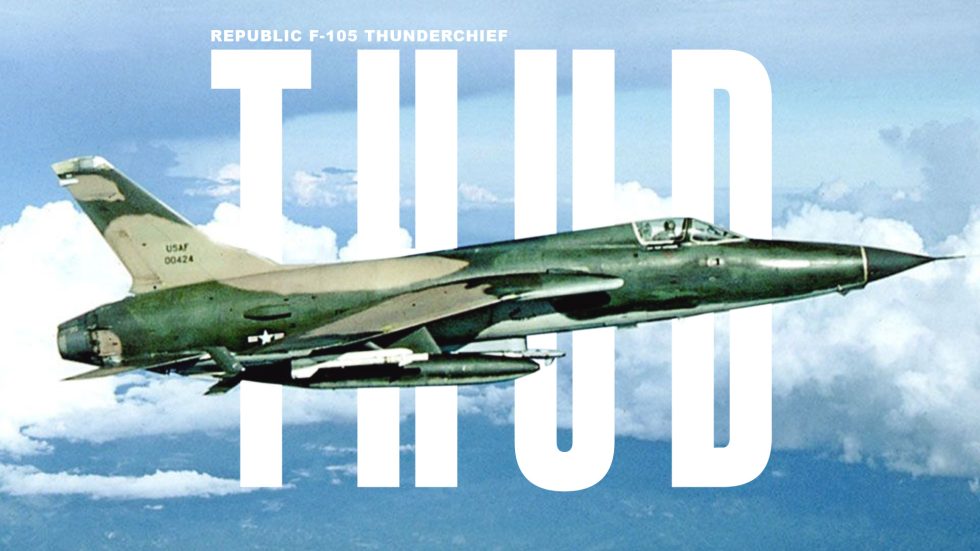
The Republic F-105 Thunderchief, nicknamed “Thud,” was a 1950s supersonic fighter-bomber designed for nuclear strikes, achieving Mach 2 speeds with J75 engines and carrying 14,000 pounds of ordnance plus a 20mm Vulcan cannon. As USAF’s primary Vietnam strike aircraft, it flew 20,000 sorties, pioneered Wild Weasel SEADSEAD (Suppression of Enemy Air Defenses): A military operation designed to neutralize, destroy, or temporarily degrade enemy air defense systems to al... More tactics, but suffered high losses before 1984 retirement.
F-105 Thunderchief – Thunder in the Skies
The Republic F-105 Thunderchief, known to its crews as the Thud, was a cornerstone of US Air Force strike capability during the early Cold War and Vietnam War. Designed in the 1950s as a supersonic fighter-bomber, it was initially conceived to deliver a nuclear payload at low altitude, reaching speeds of Mach 2. With a 14,000-pound payload and a 20mm Vulcan cannon, the F-105D variant became the Air Force’s primary tactical strike aircraft. The largest single-seat, single-engine combat aircraft of its era, it flew over 20,000 sorties in Vietnam, facing intense enemy defences. Despite its versatility, the Thunderchief suffered heavy losses. We will look at the F-105’s development, its critical role in Vietnam, and its evolution into a Wild Weasel platform, remembering a pivotal chapter in military aviation history.
In the early 1950s, Republic Aviation aimed to succeed its F-84F Thunderstreak with a supersonic fighter-bomber optimized for nuclear strikes. In 1951, the U.S. Air Force’s Tactical Air Command issued requirements for a fighter-bomber capable of delivering a 10,000-pound nuclear weapon, such as the Mk 28, at low altitude to counter Soviet ground forces in Europe. Led by Alexander Kartveli, designer of the P-47 Thunderbolt, Republic launched the F-105 project as a private venture to meet these demands for high-speed, low-altitude penetration missions. The Thunderchief featured a robust airframe, powered by Pratt & Whitney J75 turbojets—early models used J75-P-3 or J75-P-5 variants, while later F-105Ds adopted the J75-P-19W, delivering 24,500 pounds of thrust with afterburner—enabling Mach 2 performance. Its design included a large internal bomb bay for a nuclear payload, swept-forward wing-root intakes for improved aerodynamics, a T-tail for high-speed stability, variable-geometry intakes for engine efficiency, and a 20mm M61 Vulcan cannon for defensive capability. The AN/ASG-19 Thunderstick fire control system integrated radar and bombing computers, enhancing precision strikes.
The YF-105A prototype took flight on October 22, 1955, but development encountered significant obstacles. Aerodynamic drag required area-ruling adjustments to reduce supersonic resistance, and a 1956 YF-105B crash due to hydraulic and structural issues during high-speed testing required additional refinements, briefly delaying flight evaluations. Transitioning from the Allison J71 interim engine to the more powerful J75-P-3 and 5 in F-105Bs, and later the J75-P-19W in F-105Ds, caused further delays, as did integration of advanced avionics, including the NASARR R-14A radar and AN/ASG-19 system. The Air Force initially contracted for 132 F-105Bs in 1952, with plans for up to 199, but Cold War budget constraints and President Eisenhower’s ‘New Look’ policy, which prioritized missiles over tactical aircraft, reduced this to 75, redirecting funds to the F-105D and F-105F. In 1958, the F-105B entered service with the 4th Tactical Fighter Wing at Eglin AFB, equipped with radar and navigation upgrades.
By 1960, the F-105D, with all-weather capability and enhanced targeting systems, became the definitive variant, with 610 units produced. Capable of carrying 14,000 pounds of ordnance, including conventional bombs and missiles, the F-105D was a technological leap. However, its complex hydraulic, radar, and avionics systems posed maintenance challenges, requiring extensive ground crew training. Republic established specialized maintenance programs at Eglin AFB to prepare crews for these demands. Despite early setbacks, the Thunderchief proved its potential as a versatile strike platform, setting the stage for its critical role in the escalating Vietnam War.
Operational History – The Vietnam War
When the Vietnam War intensified in 1965, the Republic F-105 Thunderchief, primarily the F-105D variant, became the U.S. Air Force’s principal strike aircraft for Operations Rolling Thunder, Steel Tiger, and Barrel Roll. Assigned to units like the 355th and 388th Tactical Fighter Wings, based at Takhli and Korat Royal Thai Air Bases, F-105s flew over 20,000 sorties between 1965 and 1970, delivering more ordnance than World War II B-17 bombers, contributing significantly to the USAF’s 1.5 million tons of bombs dropped in Vietnam. Their primary targets included North Vietnamese bridges, railways, supply depots, and military installations, often in heavily defended areas around Hanoi and Haiphong. Key targets included the Thanh Hoa Bridge, a heavily fortified rail and road link, and the Yen Bai airfield, a MiG base. Carrying up to 14,000 pounds of bombs, including 750-pound M117s, 3,000-pound M118s, and occasionally AGM-12 Bullpup missiles, the Thunderchief excelled at low-altitude, high-speed strikes, leveraging its Mach 2 capability (1,390 mph at altitude) to evade defences. The AN/APN-131 Doppler radar enabled precise navigation at 500 feet, enhancing its terrain-following effectiveness.
However, these missions exposed the F-105 to formidable threats. North Vietnamese forces employed SA-2 Guideline surface-to-air missiles (S-75 Dvina), with over 150 SAMSurface-to-Air Missile: A ground-based or ship-launched guided missile system designed to detect, track, and destroy enemy aircraft, helicopters, crui... More sites by 1967. There was also dense anti-aircraft artillery (7,000 guns, including 57mm and 85mm), and MiG-17 and MiG-21 fighters, creating one of the most defended airspaces in history. F-105 squadrons, often escorted by F-4 Phantom IIs for MiG suppression, adopted tactics like dive-bombing from 15,000 feet and terrain-masking at low altitude to minimize exposure, guided by the AN/ASG-19 Thunderstick fire control system. Despite these measures, losses mounted rapidly. Of the 833 F-105s produced, 382 were lost in Vietnam—334 in combat, 48 to accidents—yielding a 40 percent attrition rate, the highest of any U.S. aircraft in the conflict. Most losses were attributed to ground fire (e.g., AAA during low-level runs) and SA-2 missiles, particularly during ingress and egress over target areas. The F-105’s large size (64.5 feet long, 50,000 pounds gross weight) and single-engine design made it vulnerable. Not to mention its complex hydraulic and avionics systems complicated battle-damage recovery, often requiring extensive repairs at forward bases like Da Nang. By 1970, the Air Force began phasing out the F-105 from strike roles, replacing it with the more survivable F-4 Phantom II and F-111 Aardvark, which offered twin engines and advanced terrain-following radar.
Despite these challenges, the Thunderchief demonstrated remarkable resilience and versatility. Pilots underwent rigorous 100-hour combat readiness courses at Nellis AFB, mastering low-altitude tactics and the F-105’s NASARR R-14A all-purpose monopulse radar for all-weather bombing. Beyond its bombing role, the F-105 achieved notable success in air-to-air combat. Equipped with a 20mm M61 Vulcan cannon, capable of firing 6,000 rounds per minute, F-105 pilots recorded 27.5 confirmed kills—all MiG-17s—using cannon fire in close-range dogfights. These engagements, though rare, highlighted the aircraft’s surprising agility and the skill of pilots like Major Ralph Kuster, who downed a MiG-17 on June 9, 1968, over Hanoi. The F-105’s fire control system, optimized for ground attack, was adapted effectively for air combat, with pilots using the AN/ASG-19’s lead-computing gunsight to engage MiGs, demonstrating its multi-role potential.
A defining moment came on August 11, 1967, when F-105s from the 335th and 338th Tactical Fighter Squadrons targeted the Paul Doumer Bridge, a critical North Vietnamese supply artery near Hanoi carrying 90 percent of rail traffic to the south. Flying through intense anti-aircraft fire and SAMSurface-to-Air Missile: A ground-based or ship-launched guided missile system designed to detect, track, and destroy enemy aircraft, helicopters, crui... More barrages, with over 200 AAA guns and multiple SA-2 sites defending the area, the squadrons delivered precision strikes with 3,000-pound M118 bombs, collapsing two spans and temporarily disabling the bridge. The mission, planned with detailed reconnaissance from RF-101 Voodoos, required split-second timing and coordination, but came at a cost, with one F-105 lost and several damaged. Another notable operation occurred on May 19, 1967, when F-105s struck the Hanoi thermal power plant, a key industrial target, under similar conditions, further demonstrating the aircraft’s ability to hit high-value targets in contested airspace. Such operations cemented the Thunderchief’s reputation as a workhorse, capable of executing complex missions despite extreme risks.
The F-105’s Vietnam experience showed that its unmatched payload and speed enabled devastating strikes, but its high loss rate exposed the limits of its design in a conventional war. Many crews flew over 100 missions, often completing the required 100-mission tour over North Vietnam to earn rotation, with pilots like Colonel Jack Broughton earning decorations such as the Distinguished Flying Cross and Silver Star for leadership in strikes. The 355th TFW alone received three Presidential Unit Citations for its F-105 operations. By the time the F-105 withdrew from combat in 1970, it had reshaped tactical bombing doctrine, emphasizing low-altitude penetration and precision strikes, paving the way for future platforms like the F-111 and F-16. The Thunderchief’s performance in Vietnam, marked by sacrifice and adaptability, set the stage for its evolution into a specialized role that would further distinguish its service.
The Wild Weasel Role
As North Vietnam’s SA-2 surface-to-air missileSurface-to-Air Missile: A ground-based or ship-launched guided missile system designed to detect, track, and destroy enemy aircraft, helicopters, crui... More systems posed an increasing threat to US air operations, the F-105 adapted to new, high-risk tasking: Suppression of Enemy Air Defences, or SEADSEAD (Suppression of Enemy Air Defenses): A military operation designed to neutralize, destroy, or temporarily degrade enemy air defense systems to al... More. This role, known as Wild Weasel, transformed the F-105 into a hunter of SAMSurface-to-Air Missile: A ground-based or ship-launched guided missile system designed to detect, track, and destroy enemy aircraft, helicopters, crui... More sites. The program began in 1965 with the F-105F, a two-seat trainer variant modified with specialized radar homing and warning receivers to detect SA-2 radar emissions, along with AGM-45 Shrike anti-radiation missiles to target radar installations. Additional modifications included enhanced cockpit displays for the Electronic Warfare Officer, enabling real-time threat analysis.
By 1966, the dedicated F-105G variant, with 61 units converted, became the primary Wild Weasel platform. Equipped with radar homing and warning receivers and AGM-45 Shrike anti-radiation missiles, these aircraft could detect, locate, and destroy SA-2 radar installations. The F-105G’s electronic countermeasures systems, including jamming pods, enhanced its survivability against missile threats.
Wild Weasel missions were among the most dangerous in Vietnam. Operating under the motto “First In, Last Out,” F-105 crews deliberately drew SAMSurface-to-Air Missile: A ground-based or ship-launched guided missile system designed to detect, track, and destroy enemy aircraft, helicopters, crui... More fire to bait radar operators into revealing their positions. Once detected, pilots launched Shrike missiles or delivered bombs to neutralize the sites, protecting strike packages of F-105s, F-4s, and B-52s. The two-seat configuration allowed an Electronic Warfare Officer to manage radar detection and targeting, improving mission effectiveness. These operations required precise coordination and nerves of steel, as crews faced intense anti-aircraft fire and MiG threats while lingering over hostile territory. The informal Wild Weasel motto, “You Gotta Be Shittin’ Me,” captured the mission’s audacity, reportedly coined by an officer briefed on its dangers.
The F-105 Wild Weasels proved highly effective, significantly reducing the SA-2 threat. Their undeniable impact came at a cost, with approximately 35 F-105F and F-105G aircraft lost, primarily to ground fire. Two F-105 pilots, Captain Merlyn H. Dethlefsen and Captain Leo K. Thorsness, earned the Medal of Honor for extraordinary heroism on Wild Weasel missions in 1967. Dethlefsen pressed an attack on a SAMSurface-to-Air Missile: A ground-based or ship-launched guided missile system designed to detect, track, and destroy enemy aircraft, helicopters, crui... More site despite heavy damage, while Thorsness destroyed two SAMSurface-to-Air Missile: A ground-based or ship-launched guided missile system designed to detect, track, and destroy enemy aircraft, helicopters, crui... More sites and downed two MiG-17s in a single sortie. The Wild Weasel crews were certainly skillful and brave.
The F-105G continued SEADSEAD (Suppression of Enemy Air Defenses): A military operation designed to neutralize, destroy, or temporarily degrade enemy air defense systems to al... More operations until 1973, with some aircraft serving in post-Vietnam roles with Air National Guard units until their retirement in 1984. The Wild Weasel mission pioneered tactics and technologies that remain central to modern SEADSEAD (Suppression of Enemy Air Defenses): A military operation designed to neutralize, destroy, or temporarily degrade enemy air defense systems to al... More platforms like the F-16CJ. By countering one of the Vietnam War’s most lethal defences, the F-105 Wild Weasels not only protected American aircrews but also reshaped aerial warfare, thus the Thud’s legacy as a versatile and resilient combat aircraft.
Legacy and Retirement
By 1970, the F-105 Thunderchief was phased out of Vietnam strike missions, replaced by the more survivable F-4 Phantom II and F-111 Aardvark. Its high loss rate—382 of 833 aircraft—prompted the shift, though the F-105G Wild Weasel variant continued Suppression of Enemy Air Defences operations until 1973.
Post-Vietnam, the F-105 served with Air National Guard and Air Force Reserve units, including the 466th Tactical Fighter Squadron at Hill Air Force Base, Utah, and the 301st Tactical Fighter Wing at Carswell Air Force Base, Texas. These units maintained F-105Ds and Gs for training and tactical roles until the aircraft’s final retirement in 1984, when it was succeeded by the F-4G Wild Weasel and F-16.
Approximately 90 F-105s are preserved today, displayed at institutions like the National Museum of the United States Air Force and Hickory Aviation Museum, where they stand as testaments to the aircraft’s service. The Thunderchief’s legacy endures in its pioneering contributions to low-altitude strike tactics and SEADSEAD (Suppression of Enemy Air Defenses): A military operation designed to neutralize, destroy, or temporarily degrade enemy air defense systems to al... More missions – shaping doctrines for precision bombing and electronic warfare and influencing platforms like the F-16CJ and F-35. The F-105’s evolution from nuclear strike to conventional bombing to Wild Weasel roles demonstrated remarkable versatility for an airframe conceived in the mid-1950s.


